
1 What draws me to this area
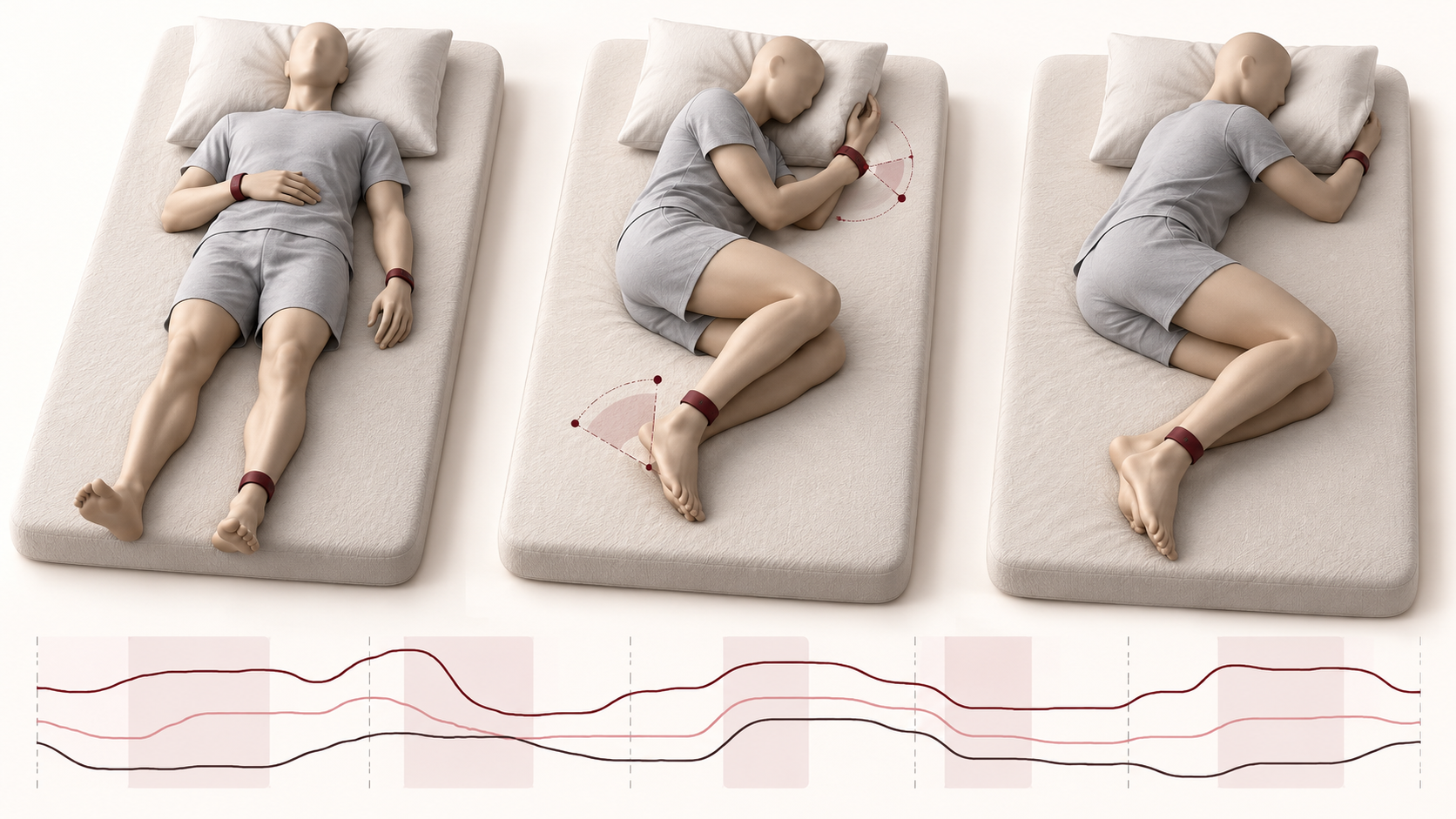
I am interested in how wearable technologies can help us understand body posture and movement during sleep. This area brings together several things that motivate my research: developing sensing systems, understanding human biomechanics, and turning measurements into information that clinicians and lay users can interpret and act upon.
Beyond recognising an individual posture, I am interested in the patterns that emerge over time: how positions change, how long they are maintained, and what we can learn from the relationship between in-bed posture/movement and other physiological phenomena.
2 Questions that interest me
Some of the questions I explore include:
- How much can we learn about body posture from a finite set of biomechanical and sensor measurements?
- How can we recognise different postures when collecting large labelled datasets is difficult?
- How can we describe posture changes and periods of inactivity in an understandable way?
These questions also open opportunities to connect wearable sensing with wider interests in biomechanics, human movement and healthcare engineering.
3 Bringing sensing and interpretation together
My work combines bespoke wearable sensor development, measurements of joint orientation and movement, and computational methods for recognising patterns. I am particularly interested in representations that connect sensor measurements to the biophysical quantities they describe.
Rather than treating sensing and analysis as separate tasks, I explore how the choice of measurements and the methods used to interpret them can work together to provide useful information about posture and movement.
4 Contributions from my work
Working with collaborators, I have explored how complex sleep postures can be recognised from joint-angle information using very limited labelled training data. Our one-shot learning framework examined twelve non-standard postures through computer-generated data and a human-participant pilot study, bringing together wearable sensing, sensor fusion and kinematic data augmentation. Read the posture-learning paper.
A complementary strand of work examines when posture changes occur and how periods of postural inactivity can be described. We developed an interpretable framework using wrist kinematics, evaluated in a controlled study with five healthy participants during simulated sleep. This connects posture recognition with an understanding of movement over time. Read the posture-change and inactivity paper.
Together, these studies contribute methods for analysing sleep-related posture and movement, while providing a foundation for further investigation in varied contexts.
5 Possibilities and connections
I am interested in extending this work towards sensing approaches that are practical, adaptable and informative beyond controlled experiments. Possible directions include understanding differences between individuals, learning with limited examples, and exploring how movement information could support broader biomechanics and healthcare research.
I would welcome conversations with researchers, clinicians and prospective research students who share these interests—or who bring complementary ideas. There is room for contributions spanning sensor development, intelligent algorithms, experimental biomechanics and the interpretation of human movement.
.
6 Selected work
- Posture recognition with limited examples: One-shot learning using extremity joint kinematics — Information Fusion, 2023.
- Movement over time: Posture-change detection and inactivity segmentation using wrist kinematics — Scientific Reports, 2023.
- A broader perspective: Sleep posture analysis: clinical, sensing and intelligent perception perspectives — book chapter, 2025.